Planning an 85 Inch or Larger TV Installation
An 85 inch or larger TV needs a plan for the model’s weight and mounting pattern, the wall support, the route into the room and the space required when the bracket moves. Diagonal size alone cannot confirm compatibility. Javi’s includes two installers for TVs 65 inches or larger; unusual access and specialty displays need a separate scope review.
In this guide
Check the Path Into the Room
Measure the actual packaged and unpackaged TV dimensions before assuming it can pass through a doorway, turn on a stair landing or fit between built-ins. Keep the route and work area clear. Tell us about stairs, tight corners and obstacles when discussing the job; a wall that fits the screen does not guarantee an easy route to it.
Keep the manufacturer’s handling instructions and packaging available. We do not ask you to choose a customer-lifting option in order to obtain the standard price.
85 and 98 Inches Are Different Room Footprints
For a 16:9 picture, 85 inches is approximately 74.1 inches wide and 41.7 inches tall. At 98 inches, it is about 85.4 by 48.0 inches. The real TV body varies. Compare the manufacturer’s dimensions with the wall and mark the outline before deciding the viewing height.
Leave space for the soundbar and confirm access to ports. An attractive front view should not prevent changing a cable or reaching connected equipment later.
Match the TV, Bracket and Wall Together
Use the exact model number, weight, VESA pattern and bracket rating. Check both the load and the usable movement. An arm may extend far enough for a smaller TV to swivel but leave a wider screen unable to turn as far without touching the wall.
Brick, stone, a fireplace surround or an unfamiliar wall assembly needs specific assessment. See the wall-type comparison. A screen being under a bracket’s nominal maximum diagonal is not the only compatibility test.
A 98 Inch TCL and Sonos Project in Fisherville
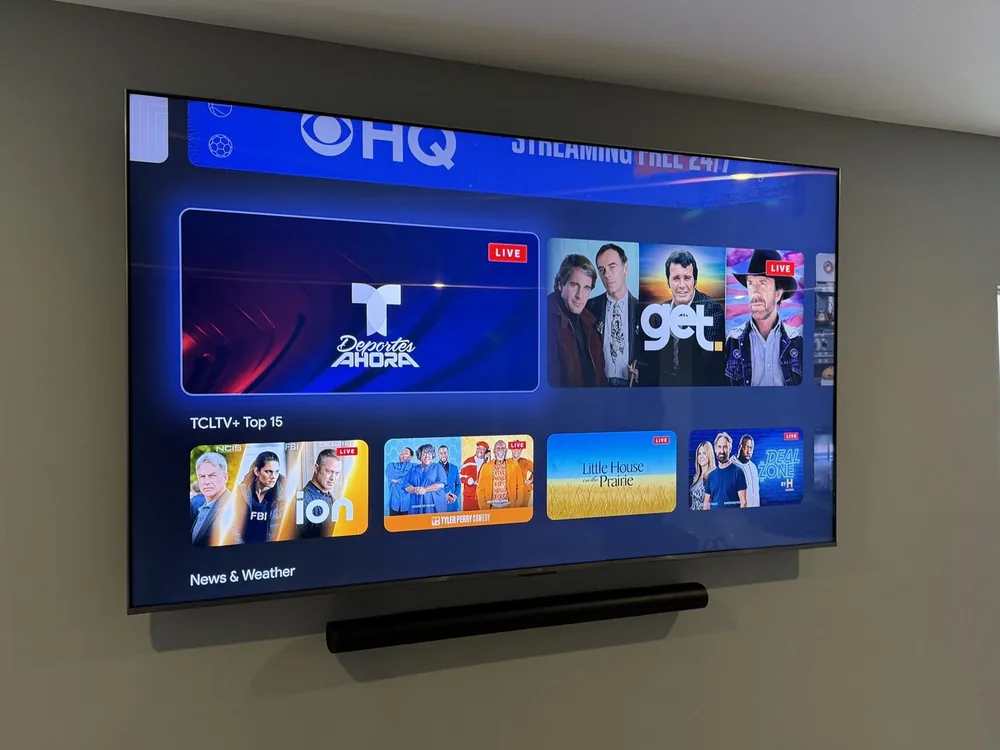
In this Fisherville installation, a 98 inch TCL and Sonos Arc Ultra were mounted with concealed wiring. The project page also links the placement and installation sequence, including the taped screen area. It connects the planning step with the completed TV and soundbar arrangement.
The photograph is evidence of that job, not a claim that every large screen uses the same bracket, wall or price. See our Fisherville service page for local options.
Understand the Current Size Bands
For one standard TV on drywall with your compatible mount, visible cables and no soundbar, the 32–85 inch band is $210 and the 86–110 inch band is $320. Supplied brackets and cable finishes change the total; large-screen bracket options have their own rates.
Compare 85 inch service examples or select the correct band on the large TV service page. Art TVs use their own packages rather than these standard examples.
What Requires Extra Planning?
A display larger than 110 inches, an integrated specialty system, a pull-down mount, unusual wall support or difficult access should be discussed before booking a listed setup. Avoid choosing a smaller size band to make a price appear. Above a fireplace, screen weight and size do not replace the heat, mantel and cable checks.
Questions Homeowners Ask
Does an 85 inch TV use the 86–110 inch price?
No. The current standard band includes 85 inches. A standard 86 inch TV starts the larger band.
Can I use my existing large-TV bracket?
Possibly. We need its model, parts, load rating and mounting pattern, along with the TV and wall details.
Can you mount a soundbar with a 98 inch TV?
Yes, when the equipment and layout are suitable. Select the soundbar separately and plan its clearance and connections with the screen.
Is every large TV an Art TV?
No. Size and service family are different selections. Choose the actual display family rather than deciding from diagonal alone.
Your Next Step
See large TV mounting or build an 86–110 inch standard installation quote.
Explore related decisions in our TV Mounting Guides.